Hydrodynamic cavitation-assisted wort boiling: energy savings without compromising beer quality
DOI:
https://doi.org/10.18832/kp2026.72.1256Keywords:
hydrodynamic cavitation, sensory, analysis, wort, beer, energy consumptionAbstract
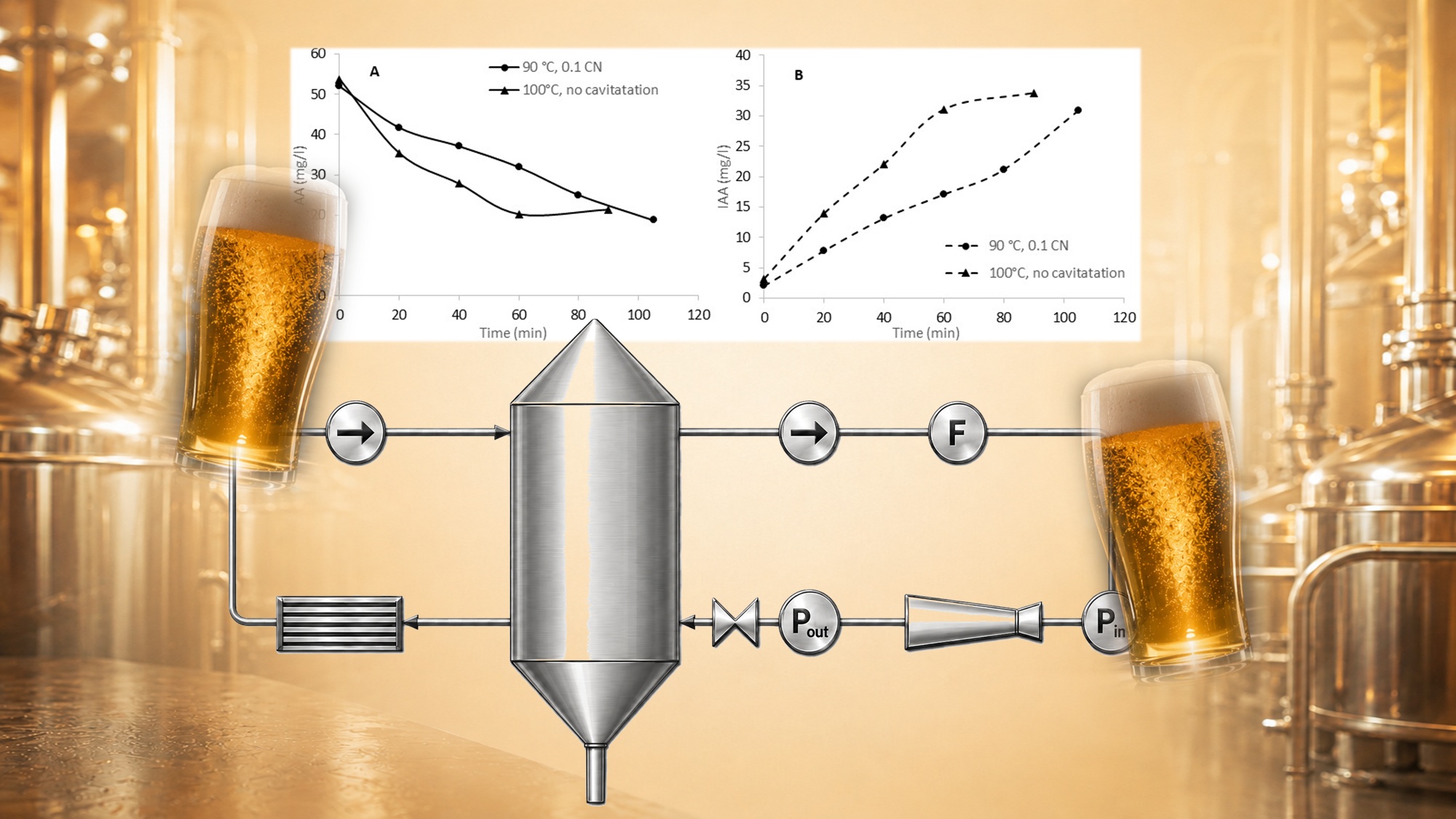
From both environmental and economic perspectives, it is desirable to minimize energy consumption during brewing while maximizing raw material utilization. One of the most energy-intensive steps in brewing is wort boiling, which can be intensified through the application of hydrodynamic cavitation. This study compares two beer production processes that differ in wort treatment/boiling: one using hydrodynamic cavitation-assisted (HC-assisted) treatment at 90 °C for 80 min, followed by short wort boiling for 15 min, and the other using a conventional wort boiling process for 90 min. The resulting worts and lager beers showed very similar key parameters in terms of analytical composition, sensory evaluation, and colloidal stability. Notably, the HC-assisted process reduced energy consumption during wort boiling by approximately 33%. These findings demonstrate the potential of hydrodynamic cavitation as an effective approach for improving the sustainability and efficiency of beer production without compromising product quality.
Downloads
References
Albanese L., Ciriminna R., Meneguzzo F., Pagliaro M. (2017). Gluten reduction in beer by hydrodynamic cavitation assisted brewing of barely malts, LWT – Food Science and Technology, 82, 342–353. https://doi.org/10.1016/j.lwt.2017.04.060
Arya S.S., Sawant O., Sonawane S.K., Show P.L, Waghamare A., Hilares R., Dos Santos J.C. (2019). Novel, nonthermal, energy efficient, industrially scalable hydrodynamic cavitation – Applications in food processing, Food Reviews International, 36(7), 668–691. https://doi.org/10.1080/87559129.2019.1669163
Asaithambi N., Singha P., Dwivedi M., Singh S.K. (2019). Hydrodynamic cavitation and its application in food and beverage industry: A review. Journal of Food Process Engineering, 42(5), e13144. https://doi.org/10.1111/jfpe.13144
Bamforth C.W. (2014). Dimethyl sulfide – significance, origins, and control. Journal of the American Society of Brewing Chemists, 72(3), 165–168. https://doi.org/10.1094/asbcj-2014-0610-01
Basarova G., Savel J., Basar P., Basarova P., Lejsek T. (2017) The Comprehensive Guide to Brewing: From Raw Material to Packaging, Fachverlag Hans Carl GmbH, Nuremberg, Germany, pp. 856. ISBN 978-3-418-00924-7
Briggs D.E., Boulton C.A., Brookes P.A., Stevens R. (2004) Hot wort clarification. In Brewing: Science and practice (pp. 349–355). Woodhead Publishing, Cambridge, England. ISBN 1-85573-490-7
Carpenter J., Badve M., Rajoriya S., George S., Saharan V.K., Pandit A.B. (2017). Hydrodynamic cavitation: an emerging technology for the intensification of various chemical and physical processes in a chemical process industry. Reviews in Chemical Engineering, 33(5), 433–468. https://doi.org/10.1515/revce-2016-0032
Chuah L.F., Klemes J.J., Yusup S., Bokhari A., Akbar M.M., Chong Z.K. (2017). Kinetic studies on waste cooking oil into biodiesel via hydrodynamic cavitation. Journal of Cleaner Production, 146, 47–56. https://doi.org/10.1016/j.jclepro.2016.06.187
Dai X., Wang P., Wu W., Wang H., Xu Q., Li Z. (2022) Separation of Dimethyl Sulfide from Wort by Multi-Layer Centrifugal Film Method. Foods, 11(18), 2901. https://doi.org/10.3390/foods11182901
Desobgo Z.S.C., Stafford R.A., Metcalfe D.J.A. (2015). Dimethyl sulfide stripping behavior during wort boiling using response surface methodology. Journal of the American Society of Brewing Chemists, 73(1), 84–89. https://doi.org/10.1094/asbcj-2015-0103-01
EBC (2026). European Brewery Convention. Analytica EBC [Online]. Available at: https://brewup.eu/ebc-analytica/search [Accessed 25 Feb 2026].
Fisher S., Russ W., Meyer-Pittroff R. (2002). High pressure advantages for brewery processes. Progress in Biotechnology, 19, 397–404. https://doi.org/10.1016/S0921-0423(02)80130-7
Gogate P.R., Pandit A.B. (2001). Hydrodynamic cavitation reactors: A state of the art review. Reviews in Chemical Engineering, 17(1), 1–85. https://doi.org/10.1515/revce.2001.17.1.1
Jahoda M., Holeček O., Schreiberová L. (2026). E-tables. https://uchi.vscht.cz/study/etables [Accessed Feb 26, 2026].
Kucharczyk K., Żyła K., Tuszyński T. (2020) Simultaneous Optimization of Acetaldehyde and DMS Concentrations for Better Sensory Quality of Beer Fermented on an Industrial Scale. Foods, 9(8), 1043. https://doi.org/10.3390/foods9081043
Kühbeck F., Schütz M., Thiele F., Krottenthaler M., Back W. (2006) Influence of Lauter Turbidity and Hot Trub on Wort Composition, Fermentation, and Beer Quality. Journal of the American Society of Brewing Chemists, 64(1), 16–28. https://doi.org/10.1094/ASBCJ-64-0016
Kunze W. (2004) Brewhouse yield. In Technology brewing and malting (3rd rev. ed., Section 3.5). VLB Berlin, Germany. ISBN 3-921690-49-8
Malfliet S., Opstaele F., Clippeleer J., Syryn E., Goiris K., Cooman L., Aerts G. (2008). Flavour instability of pale lager beers: Determination of analytical markers in relation to sensory ageing. Journal of the Institute of Brewing. Institute of Brewing, 114(2), 180–192. https://doi.org/10.1002/j.2050-0416.2008.tb00324.x
Malowicki M.G., Shellhammer T.H. (2005). Isomerization and degradation kinetics of hop (Humulus lupulus) acids in a model wort-boiling system. Journal of Agricultural and Food Chemistry, 53(11), 4434–4439. https://doi.org/10.1021/jf0481296
MEBAK (2013). Collection of Brewing Analysis Methods of the Mitteleuropäische Brautechnische Analysenkommission. Wort, Beer, Beer-based beverages, Fachverlag Hans Carl, Nürenberg. ISBN 978-3-9805814-7-9
Meneguzzo F., ZabiniF. (2025). Industrialization of hydrodynamic cavitation in plant resource extraction. Current Opinion in Chemical Engineering, 48, 101140. https://doi.org/10.1016/j.coche.2025.101140
Mikyška A., Štěrba K. (2023). Effect of Wort Boiling System and Hopping Regime on Wort and Beer Stale-Flavor Aldehydes. Foods, 12(16), 3111. https://doi.org/10.3390/foods12163111
Milly P.J., Toledo R.T., Harrison M.A., Armstead D. (2007). Inactivation of food spoilage microorganisms by hydrodynamic cavitation to achieve pasteurization and sterilization of fluid foods. Journal of Food Science, 72(9), M414–M22. https://doi.org/10.1111/j.1750-3841.2007.00543.x
Olaniran A.O., Hiralal L., Mokoena M.P., Pillay B. (2017). Flavour-active volatile compounds in beer: production, regulation and control: Flavour-active volatile compounds in beer: production, regulation and control. Journal of the Institute of Brewing. Institute of Brewing (Great Britain), 123(1), 13–23. https://doi.org/10.1002/jib.389
Šarc A., Stepišnik-Perdih T., Petkovšek M., Dular M. (2017). The issue of cavitation number value in studies of water treatment by hydrodynamic cavitation. Ultrasonics Sonochemistry, 34, 51–59. https://doi.org/10.1016/j.ultsonch.2016.05.020
Štěrba, J., Punčochář M., Brányik T. (2024). The effect of hydrodynamic cavitation on isomerization of hop alpha-acids, wort quality and energy consumption during wort boiling. Food and Bioproducts Processing, 144, 214–219. https://doi.org/10.1016/j.fbp.2024.02.001
Vajnhandl S., Majcen Le Marechal A. (2005). Ultrasound in textile dyeing and the decolouration/mineralization of textile dyes. Dyes and Pigments: An International Journal, 65(2), 89–101. https://doi.org/10.1016/j.dyepig.2004.06.012
Weinzierl M., Stippler K., Wasmuht K., Miedaner H., Englmann J. (1999) Ein neues Würzekochsystem, Part I: Erste Ergebnisse aus Pilotversuchen, Brauwelt 139(5), 185–189.
Downloads
Published
Issue
Section
License
Copyright (c) 2026 Jiří Štěrba, Miroslav Punčochář, Alexandr Mikyška, Tomáš Brányik

This work is licensed under a Creative Commons Attribution 4.0 International License.