Could endophytic bacteria Pantoea agglomerans isolated from hop cones contaminate beer?
DOI:
https://doi.org/10.18832/kp2026.72.1249Keywords:
Pantoea agglomerans, hop endophyte, risk of beer contaminationAbstract
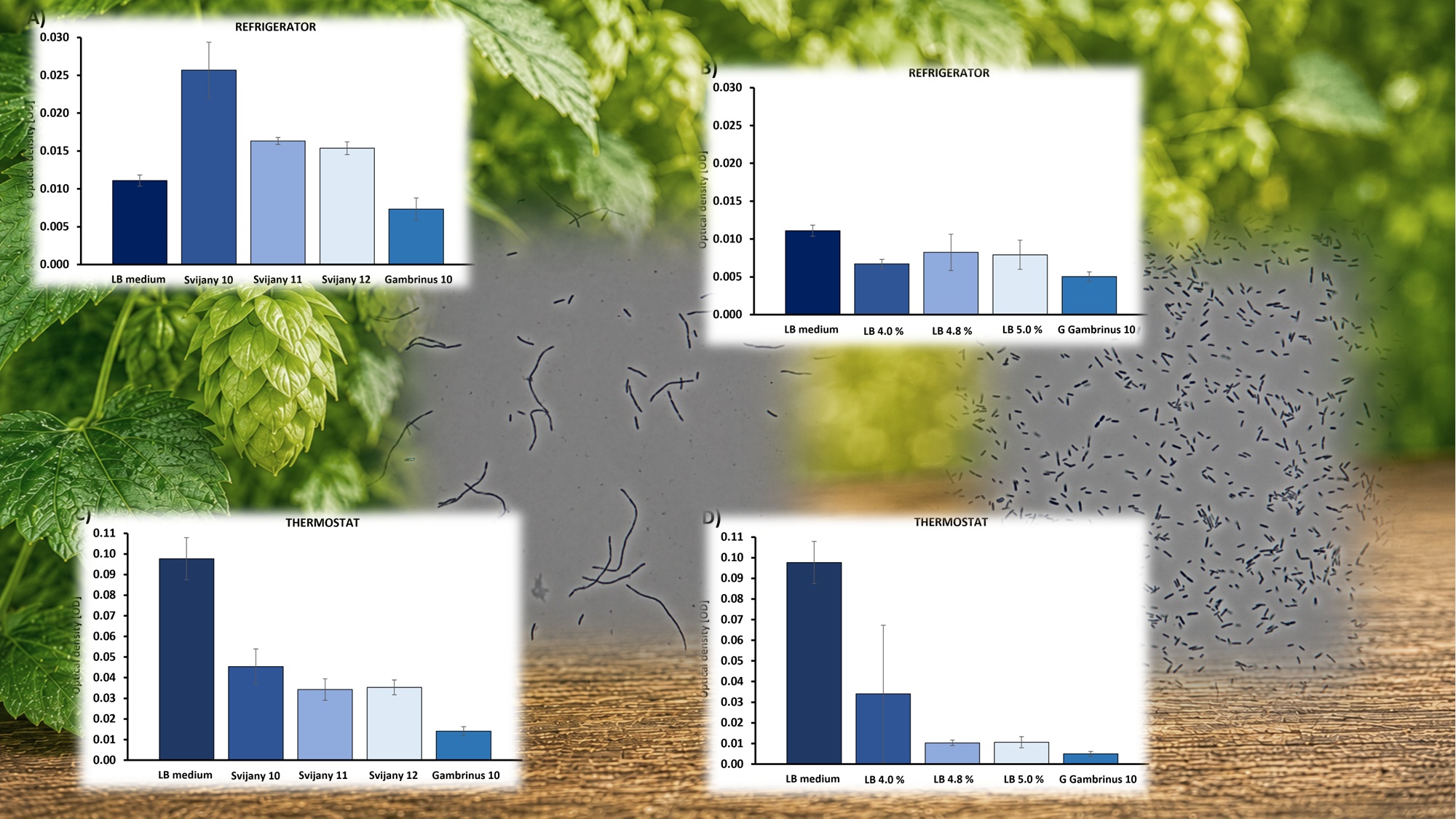
Gram-positive bacteria, particularly lactic acid bacteria, are generally considered the primary potential contaminants of beer. However, given recent publications on the isolation of Gram-negative bacteria from hop pellets, it is important to also consider whether endophytic bacteria found in the above-ground parts of the hop plant, such as the facultatively anaerobic bacterium Pantoea agglomerans, might pose a potential risk during so-called dry hopping of beer. To find an answer to this question, we conducted practical experiments in which we intentionally inoculated various types of alcoholic and non-alcoholic beers, as well as culture media mimicking the beer environment. We subjected the inoculated beers to a 5-day incubation at two temperatures: 7 °C in a refrigerator and 30 °C in a thermostat. Our observations revealed that the main factor preventing the development of this type of contamination is the low pH of the beer, which is unsuitable for bacteria. Other contributing negative factors that prevent contamination are alcohol content and oxygen limitation. The only theoretical risk of contamination could be associated with improper storage of non- alcoholic dry-hopped beer at high temperatures.
Downloads
References
Andersen A.Z., Carvalho A.L., Neves A.R., Santos H., Kummer U., Olsen L.F. (2009). The metabolic pH response in Lactococcus lactis: An integrative experimental and modelling approach. Computational Biology and Chemistry, 33, 71–83. https://doi.org/10.1016/j.compbiolchem.2008.08.001
Bocquet L., Sahpaz S., Rivière C. (2018). An Overview of the Antimicrobial Properties of Hop. In: Mérillon J.-M., Riviere C. (Eds.) Natural Antimicrobial Agents. Cham: Springer International Publishing. https://doi.org/10.1007/978-3-319-67045-4_2
Bogdanova K., Kolar M., Langova K., Dusek M., Mikyska A., Bostikova V., Bostik P., Olsovska J. (2018). Inhibitory effect of hop fractions against Gram-positive multi- resistant bacteria. A pilot study. Biomedical Papers, 162, 276–283. https://doi.org/10.5507/bp.2018.026
Costa E., Usall J., Teixidó N., Delgado J., Viñas I. (2002) Water activity, temperature, and pH effects on growth of the biocontrol agent Pantoea agglomerans CPA-2. Canadian Journal of Microbiology, 48(12), 1082–1088. https://doi.org/10.1139/w03-001
Dutkiewicz J., Mackiewicz B., Lemieszek M.K., Golec M., Milanowski J. (2016). Pantoea agglomerans: a mysterious bacterium of evil and good. Part IV. Beneficial effects. Annals of Agricultural and Environmental Medicine, 23(2), 197–205. https://doi.org/10.5604/12321966.1203878
Guan N., Liu L. (2020). Microbial response to acid stress: mechanisms and applications. Applied Microbiology and Biotechnology, 104, 51–65. https://doi.org/10.1007/s00253-019-10226-1
Hasek T., Kastanek F., Smirnova T.A., Solcova O., Kuckova S., Branska B., Melzoch K., Patakova P. (2025). Ammonia release from hydrolysed animal and food waste by the hop endophyte, Pantoea agglomerans. World Journal of Microbiology and Biotechnology, 41, 494. https://doi.org/10.1007/s11274-025-04720-0
Hrabia O., Ditrych M., Ciosek A., Fulara K., Andersen M.L., Poreda A. (2022). Effect of dry hopping on the oxidative stability of beer. Food Chemistry, 394, 133480. https://doi.org/10.1016/j.foodchem.2022.133480
Choi E.-J., Park J.-W., Kim J. H., Kim W. J. (2020). Biological acidification and beer quality: addition of lactic acid bacteria isolated from malt. Journal of The Institute of Brewing, 126, 176–183. https://doi.org/10.1002/jib.601
Jelinek L., Mullerova J., Karabin M., Dostalek P. (2018). The secret of dry hopped beers – review. Kvasny Prumysl, 64(6), 287–296. https://doi.org/10.18832/kp201836
Jones T.H., Vail K.M., Mcmullen L.M. (2013). Filament formation by foodborne bacteria under sublethal stress. International Journal of Food Microbiology, 165(2), 97–110. https://doi.org/10.1016/j.ijfoodmicro.2013.05.001
Kolek J., Patakova P., Junkova P., Krofta K., Hynek R., Dostalek P. (2021). Isolation and identification of Pantoea agglomerans from the inflated bag with dried hop pellets stored under a modified atmosphere. Journal of Applied Microbiology, 131, 281–287. https://doi.org/10.1111/jam.14970
Krofta K., Mravcova L., Kolek D., Patakova P., Patzak J., Henychova A., Dostalek P. (2021) Microbial community of hop (Humulus lupulus L.) and its impact on the quality of hop products. Acta Horticulturae, 1328, 109–114. https://doi.org/10.17660/ActaHortic.2021.1328.15
Lund P. A., De Biase D., Liran O., Scheler O., Mira N.P., Cetecioglu Z., Fernández E.N., Bover-Cid S., Hall R., Sauer M., O'byrne C. (2020). Understanding How Microorganisms Respond to Acid pH Is Central to Their Control and Successful Exploitation. Frontiers in Microbiology, 11, 556140. https://doi.org/10.3389/fmicb.2020.556140
Manzano M., Iacumin L., Vendrames M., Cecchini F., Comi G., Buiatti S. (2011). Craft Beer Microflora Identification Before and After a Cleaning Process. Journal of The Institute of Brewing, 117, 343–351. https://doi.org/10.1002/j.2050-0416.2011.tb00478.x
Patakova P., Vasylkivska M., Sedlar K., Jureckova K., Bezdicek M., Lovecka P., Branska B., Kastanek P., Krofta K. (2024). Whole genome sequencing and characterization of Pantoea agglomerans DBM 3797, endophyte, isolated from fresh hop (Humulus lupulus L.). Frontiers in Microbiology, 15, 1305338. https://doi.org/10.3389/fmicb.2024.1305338
Riccioni C., Belfiori B., Cenci M., Rubini A. (2025). Exploring Endophytic Fungi from Humulus lupulus L. for Biocontrol of Phytopathogenic Fungi. Diversity, 17(2), 94. https://doi.org/10.3390/d17020094
Roselli G.E., Kerruish D.W.M., Crow M., Smart K.A., Powell C.D. (2024). The two faces of microorganisms in traditional brewing and the implications for no- and low-alcohol beers. Frontiers in Microbiology, 15, 1346724. https://doi.org/10.3389/fmicb.2024.1346724
Sezonov G., Joseleau-Petit D., D'Ari R. (2007). Escherichia coli Physiology in Luria-Bertani Broth. Journal of Bacteriology, 189(23), 8746–8749. https://doi.org/10.1128/jb.01368-07
Sharma P., Pandey R., Chauhan N.S. (2024). Unveiling wheat growth promotion potential of phosphate solubilizing Pantoea agglomerans PS1 and PS2 through genomic, physiological, and metagenomic characterizations. Frontiers in Microbiology, 15, 1467082. https://doi.org/10.3389/fmicb.2024.1467082
Sood S., Singhal R., Bhat S., Kumar A. (2011). 2.13 – Inoculum Preparation. In: Moo-Young M. (Ed.) Comprehensive Biotechnology (Second Edition). Burlington: Academic Press, 151-164. https://doi.org/10.1016/B978-0-08-088504-9.00090-8
Takahashi M., Aoyagi H. (2018). Monitoring of CO2 and O2 concentrations in the headspace of Sakaguchi flasks during liquid culture of microorganism. Applied Microbiology and Biotechnology, 102, 6637–6645. https://doi.org/10.1007/s00253-018-9076-4
Young J., Oakley W.R.M., Fox G. (2023). Humulus lupulus and microbes: Exploring biotic causes for hop creep. Food Microbiology, 114, 104298. https://doi.org/10.1016/j.fm.2023.104298
Downloads
Published
Issue
Section
License
Copyright (c) 2026 Tomas Hasek, Lenka Mravcova, Karel Krofta, Petra Patakova

This work is licensed under a Creative Commons Attribution 4.0 International License.