Dilute and Shoot: A novel approach for determination of chlormequat and mepiquat in beer
DOI:
https://doi.org/10.18832/Keywords:
dilute and shoot, chlormequat, mepiquat, liquid chromatography, mass spectrometryAbstract
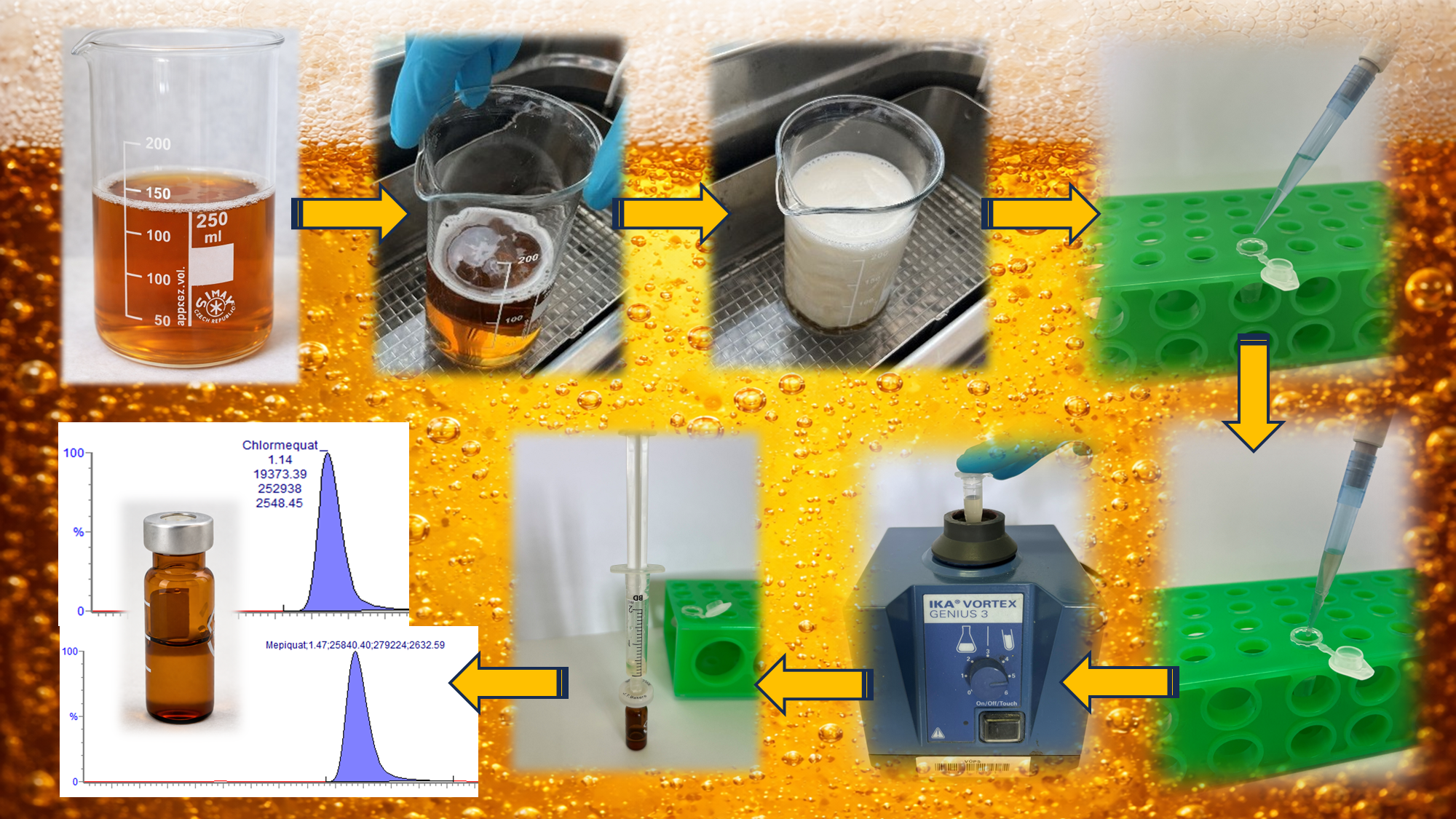
The extensive use of pesticides in agriculture has led to the presence of their residues in soil, water sources, and crops. Among these, the plant growth regulators chlormequat and mepiquat are commonly employed to regulate plant growth. The European Union has established maximum residue limits (MRLs) for different types of cereal (barley 7 mg/kg for chlormequat and 4 mg/kg for mepiquat). However, the extent to which these compounds are transferred from raw brewing materials into beer remains poorly understood, and no regulatory limits currently exist for their concentrations in beer. This study aimed to develop and validate a rapid, cost-effective, and straightforward analytical method for the simultaneous determination of chlormequat and mepiquat in beer. A Dilute and Shoot strategy was evaluated: degassed beer samples were diluted with acetonitrile and analysed using a Waters Acquity UPLC system coupled with a XEVO TQ-S micro mass spectrometer, including electrospray ionization (ESI). Chromatographic separation was achieved using an isocratic elution on a Kinetex® 1.7 μm (100 × 2.1 mm) HILIC column. Method performance was assessed in terms of linearity, detection and quantification limits, precision, and accuracy. Recoveries were 89% for chlormequat and 84% for mepiquat, with relative standard deviations (RSDs) not exceeding 4%. A total of 90 beer samples were analysed, revealing contamination in 86% of samples, with concentrations ranging from 0.1 to 28.9 μg/L.
References
Bamforth C.W. (2009). Beer A Quality Perspective. London: Academic Press. ISBN 978-0-12-669201-3, https://doi.org/10.1016/B978-0-12-669201-3.X0001-2
Bessaire T., Tarres A., Stadler R.H., Wermann S., Hofmann J., Theurillat V., Combremont R., Delatour T. (2016). Mepiquat: a process-induced byproduct in roasted cereal-based foodstuffs. Journal of agricultural and food chemistry, 64(5), 1185–1190. https://doi.org/10.1021/acs.jafc.5b05418
Deventer K., Pozo O.J., Verstraete A.G., Van Eenoo P. (2014). Dilute-and-shoot-liquid chromatography-mass spectrometry for urine analysis in doping control and analytical toxicology. TrAC Trends in Analytical Chemistry, 55, 1–13. https://doi.org/10.1016/j.trac.2013.10.012
Ekielski A., Mishra P.K., Żelaziński T. (2018). Assessing the influence of roasting process parameters on mepiquat and chlormequat formation in dark barley malts. Food and bioprocess technology, 11(6), 1177–1187. https://doi.org/10.1007/s11947-018-2087-4
Enders J.R., McIntire GL (2015). A dilute-and-shoot LC–MS method for quantitating opioids in oral fluid. Journal of Analytical Toxicology, 39(8), 662–667. https://doi: 10.1093/jat/bkv087
Esparza X., Moyano E., Galceran M.T. (2009). Analysis of chlormequat and mepiquat by hydrophilic interaction chromatography coupled to tandem mass spectrometry in food samples. Journal of Chromatography A, 1216(20), 4402-4406. https://doi: 10.1016/j.chroma.2009.03.037
European Food Safety Authority (2020). Modification of the existing maximum residue levels for chlormequat in barley and animal commodities. EFSA Journal, 18(1), e05982. https://doi.org/10.2903/j.efsa.2020.5982
European Food Safety Authority (2024). Peer review of the pesticide risk assessment of the active substance mepiquat (evaluated variant mepiquat chloride). EFSA Journal, 22(7), e8923. https://doi: 10.2903/j.efsa.2024.8923
Fera Science (n.d.). Chlormequat and Mepiquat Chloride analysis. https://www.fera.co.uk/chlormequat-and-mepiquat-chloride-analysis.html [accessed July 3, 2025]
Gutta S., Gunasekaran K., Jose A. (2021). Mepiquat Poisoning–Report of a Patient with Mepiquat Poisoning Presenting with Bradycardia and Hypoglycemia. Indian Journal of Forensic Medicine & Toxicology, 15(3). https://doi.org/10.37506/ijfmt.v15i3.15979
Kunze W. (2004). Technology brewing and malting. Berlin: VLB, 18-152. ISBN 3-921690-49-8
Martiník J., Boško R., Svoboda Z., Běláková S., Benešová K., Pernica M. (2023). Determination of mycotoxins and their dietary exposure assessment in pale lager beers using immunoaffinity columns and UPLC-MS/MS. Mycotoxin research, 39(3), 285–302. https://doi.org/10.1007/s12550-023-00492-4
Nardin T., Savastano R., Franceschini J., Abballe F., Larcher R. (2023). Risk of de-novo formation of chlormequat and mepiquat in industrial cocoa products assessed by ion chromatography coupled with high-resolution mass spectrometry. International Journal of Food Science and Technology, 58(6), 3006–3013. https://doi.org/10.1111/ijfs.16424
Noestheden M.R. (2015). Evaluation of mepiquat in malted barley and beer using LC‐MS/MS. Journal of the Institute of Brewing, 121(4), 524–530. https://doi.org/10.1002/jib.266
Nováková L., Douša M., Česla P. (2021). Moderní HPLC separace v teorii a praxi. 2. přepracované a rozšířené vydání. Brno: Česká chromatografická škola, zapsaný spolek, 2021. Brno, Česká republika
Rademacher W. (2000). Growth retardants: effects on gibberellin biosynthesis and other metabolic pathways. Annual review of plant biology, 51(1), 501-531. https://doi.org/10.1146/annurev.arplant.51.1.501
Tamama K. (2023). Dilute and shoot approach for toxicology testing. Frontiers in Chemistry, 11, 1278313. https://doi.org/10.3389/fchem.2023.1278313
Van Loco J., Elskens M., Croux C., Beernaert H. (2002). Linearity of calibration curves: use and misuse of the correlation coefficient. Accreditation and Quality Assurance, 7, 281-285. https://doi.org/10.1007/s00769-002-0487-6
Vijitharan V., Warnasekare J., Lokunarangoda C., Farah M.F., Siribaddana S.H. (2016). Fatal poisoning with plant growth regulator–chlormequat. Ceylon medical journal, 61(2). https://doi.org/10.4038/cmj.v61i2.8297
Zincke F., Kittelmann A., Scholz R., Tietz E., Michalski B. (2025). European database of processing factors for pesticides residues in food (Verze 5) [Data set]. Zenodo. https://doi.org/10.5281/zenodo.15363279
Published
Issue
Section
License
Copyright (c) 2026 Marek Pernica, Jan Martiník, Simona Černá, Zdeněk Svoboda, Karolína Benešová, Rastislav Boško, Sylvie Běláková

This work is licensed under a Creative Commons Attribution 4.0 International License.